Letting Go of Perfectionism
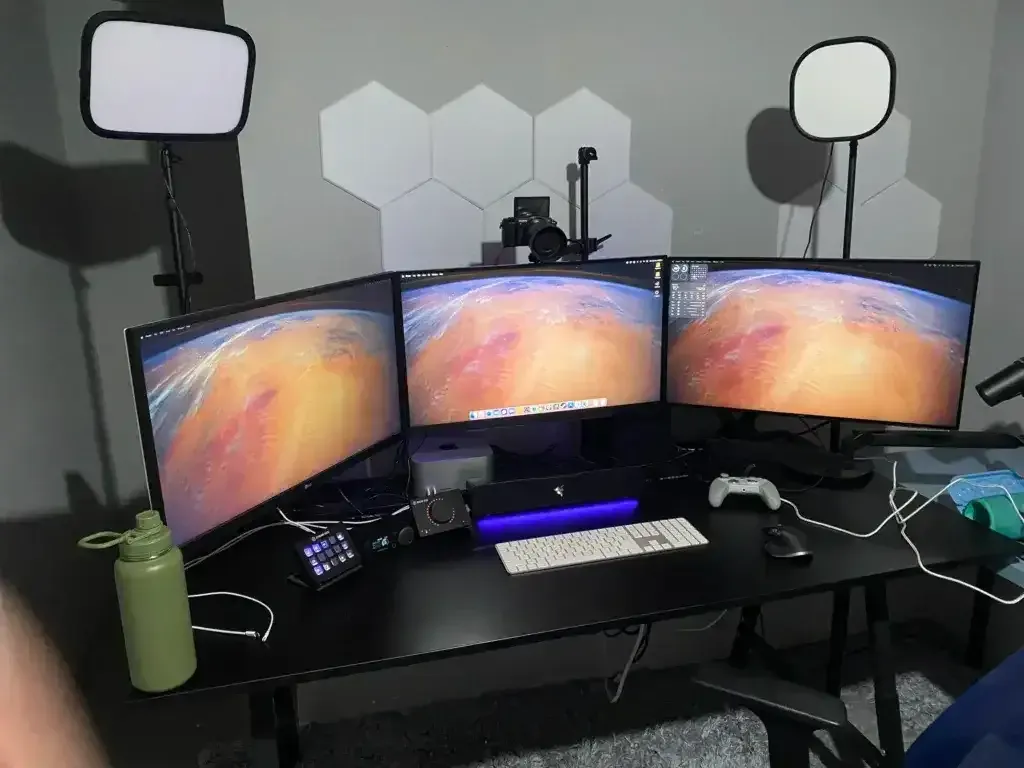
When you look at your OBS stats and see frames missed due to rendering lag, skipped frames due to encoding lag, or dropped frames during a stream, does it cause you anxiety and stress? Do you end your stream early because there is a clear problem that needs to be fixed immediately? Why did you drop six frames at the start of your stream? What caused it? how do you fix it? The rabbit hole you fall into could last hours, days, or weeks—potentially derailing all the progress you've made streaming recently.
That paragraph wasn't me making assumptions about you, dear reader. That was some insight into how I began my streaming journey. I began in 2015, and have easily spent three times the number of hours working on my stream than I have spent actually streaming. When you consider the research, testing, troubleshooting, problem-solving, and then re-researching and re-testing, it could be an even higher ratio. At one point, I thought having an asymmetrical desk setup was interfering with my green screen and spent an entire weekend rebuilding my setup and adjusting my desks.
I got stuck in perfectionism that drove me to build my "perfect" setup and then continue iterating on it over the years, sinking more money and more hours in the pursuit of perfection. I originally wrote this article in November of 2025 as a way to convince myself to stop obsessing over perfection.
What is Perfectionism?
Perfectionism is a curse that can sometimes be a blessing. It is the thing that drives me to always be better than I was, but it is also the thing that kills my drive by setting insurmountable goals. Perfectionism is my obsessive need to improve things, even when to anyone else they look objectively perfect. Nobody can see that dark spot on my camera because I cropped it out. But I know it's there, and I need to fix it. There are a lot of different definitions of what autistic perfectionism is, and my favourite has unfortunately been taken offline. It was by Rachelle Goldenberg and said, "Perfectionism means setting really high standards—sometimes impossibly high—for yourself and sometimes for others too. When things don't go exactly right, perfectionists tend to be incredibly hard on themselves."1 It looks like the article is gone now, and I can't find it on the Wayback Machine. That's unfortunate.
The idea that things can go exactly right is difficult, because they can't. Nothing is ever perfect, especially not forever. And because things change, I need to stay on top of every tiny aspect of my setup to stay ahead of this fictional measure of perfection. It doesn't matter that I'm the only one measuring the perfection in my stream—because if I see the imperfections, I need to fix them.
When the PS5 and Xbox Series X came out, they supported 4K resolution at 120Hz on compatible displays. This required HDMI 2.1, a first time for consoles and still unsupported by capture cards. I decided to upgrade to a 4K 120Hz display, but my capture card's passthrough didn't work. I replaced it with a new HDMI 2.1-compatible PCI Express card, but it was slightly taller than my older one which caused it to bend under my graphics card. Although it worked, the imperfection gnawed at me. To fix this, I installed a PCI-E extension cable, but then my capture card sat in the bottom of my case, and if I moved my PC, the HDMI cables popped out and broke the connection, or the card would pop out of the PCI-E cable.
It was off to the store to buy another capture card, this time USB. This led to additional problems, as the USB capture card had audio conflicts with my motherboard that I couldn't fix. I had spent hundreds of dollars to trade a perceived imperfection for a very real one.
Now that I had two expensive capture cards that were unsatisfying, what was my solution? Buy a new computer, of course. I moved from Windows to a Mac, as the Mac's thunderbolt ports were known to work well with my capture card. Streaming was not my primary motivator—I wanted to edit videos on Final Cut Pro and that software is exclusive to Macs. Amidst all of my research, my teenage son was showing an interest in PC gaming, so the timing actually worked out to replace my gaming PC with a Mac, and give him the PC. The Mac had its own challenges, but none of them too difficult to overcome. Since making this change, Macs have come a long way in streaming, and except for a few niche uses, I don't feel like I'm on an inferior platform at all.
How does Perfectionism impact your Stream?
Both Twitch and YouTube offer guidance on the settings you should use in your streaming software, but those guidelines don't tell you everything. Which encoder should you use? What impact will streaming via WiFI have over ethernet? Should you multistream or pick one platform? Twitch Enhanced Broadcasting or not? There are so many considerations to make when streaming, and any one of them, set incorrectly, can easily make your stream less than perfect.
Setting a bitrate your PC can't handle can lead to skipped frames. Streaming to too many sources can also lead to skipped frames. If your hard drive write speeds aren't fast enough, the write buffer overflows and, you guessed it, dropped frames. You might use your GPU to stream, but your CPU needs to manage your scenes, sources, browsers, and anything else running in the background to keep your stream looking nice.
If you go on Twitch and look up any category, you'll see a sea of streamers with cameras, overlays, VTuber models, and many of them look fantastic. They may have dozens, hundreds, or thousands of viewers, and nobody is complaining about the slight green outline from a green screen that's reflecting too much light or the animated overlay that pauses for one frame when it loops. Viewers will usually tell you about critical issues—your camera is off target, your mic is muted, and if you're lucky, they'll tell you about audio balance. But the majority of minor stream issues, nobody will say anything—if they notice at all. Your viewers aren't there to critique you or your setup—they're there to hang out with you.
After realizing that the above issues are far less important than I thought they were, I shifted my perfectionism focus on areas that actually matters to viewers. Is my voice clear? Can I be heard both during quiet moments and hectic gunfights? When I'm streaming blog writing, is the music and ambient sound detracting from the experience or enhancing it? I tend to work to the sound of rain and thunder. Maybe the peaceful clacking of a mechanical keyboard. This is especially important now that I use a nearly-silent actual keyboard.
Redefine Perfection
If you searched online for the perfect streaming setup, you would find no shortage of opinions and guides, many of which would contradict one another. This leaves the one doing the searching confused about how to do things "right."
The easiest answer is there is no one perfect setup, but by saying that, we set ourselves on a steep uphill hike. But if perfection can be defined in so many ways, how do we narrow its pursuit? Can we let go of the idea? Instead, let's try to redefine what perfection means in our own streams.
For many, the easiest milestone in the quest for perfection is adherence to a schedule. Whether your schedule is streaming one, three, six, or seven days a week, sticking to that schedule without missing a day is a key component in growth, both at small and large audience sizes. One of the things I struggle with is when I set my mind to which game I want to play, and that game has server issues. This happened in the weeks following the release of ARC Raiders, where the servers kept going down. Three of my four streams in one week ended early due to server crash. If I had been more focused on the experience, I might have shifted to Just Chatting or Writing & Reading. Instead, I focused too much on the specific game I wanted to play, closing myself off to alternatives. In my quest for perfection, I might next focus on what to do when my plans get interrupted by things out of my control.
I mentioned my green screen issues above. Over the years, I've tried many times to improve my setup. I got better lights, I used different software, different materials—including a horrendous green tablecloth from the dollar store. I've moved the lights, added desks, and although right now I seem to have the green screen working perfectly, all it takes is one modification to ambient light, or accidentally wearing the wrong colour of shirt, and I'm annoyed by a little dusty corner that doesn't look right. I sometimes doubt my green screen will ever work properly.
It's easy to fall back into old habits, and this trap extends beyond hardware and into software. I realized the danger of switching streaming applications without enough testing. Chasing the perfect UI meant jumping between OBS, StreamLabs, and Meld Studio, resulting in only frustrating software conflicts, errors, crashes, and endless headaches.
The point of these stories is not to discourage you from experimenting and learning, but to help us in redefining perfection. I view those experiments not as personal failures, but as necessary lessons. If, in pursuit of perfection, we can continue to learn, we'll get there eventually. Now, I look at small, impactful changes that are easy to undo. New alerts. New productivity tools. Different music. Ambient sound. If I don't like the rain sounds in the background, I can turn them off and keep going. When I need ot make a major change, I take some time on my non-streaming days to test exhaustively. It's still not perfect, because you can't easily test online connectivity or how things work live. I tried to create alerts for merch sales. Most days, I don't make merch sales, but I figured I'd get ahead of the game and be ready. I never got it working properly.
Thinking of perfection as incremental improvements over time, I have made custom alerts, custom subscriber badges, and other minor tweaks to my stream. Things that are meant to encourage community engagement but without causing an interference while live. One of my favourite enhancements was a rare chance for a special alert when I get a new follow.
Be Confident
Early in my streaming years, I struggled a lot with the lack of growth. I thought it must be that I didn't have a good enough camera, microphone, capture card, or PC hardware, and I kept buying new, more powerful tech to compensate. What I wasn't doing at that time was producing content for other platforms. I wasn't active on social media. I didn't use Discord.
Now, after all my learning, I still don't use Discord and I don't have social media accounts—outside of YouTube, TikTok, and Twitch. Standard streaming advice is that you need as much and as many high-quality social media accounts as possible, but I realized that for my personal stability and health, attempting to be perfect on every platform was impossible. Choosing to limit my scope gave me the bandwidth to build up the platforms I actually enjoy. Since originally posting this, I've scaled back YouTube and TikTok, and am just streaming. I keep telling myself I'll start working on secondary platforms again, but social media is just such a drain.
To be confident, you must find the perfection in what you do now, or what you're building towards. Lean into what you do, rather than what you have. Did a DSLR camera really upgrade my stream? Did an XLR microphone upgrade my audio by the same ratio as its cost?
Tobin Maclean said of perfectionism, "I feel like it is pointless for me to spend time producing art which isn't of exceptional quality, and it leads to so many of my pieces and ideas going unfinished or never even being started."2 When I was looking at my own stream and seeing its imperfections, it discouraged me from wanting to stream at all if I didn't have the best possible setup.
You may never be able to cleanse yourself of the feeling that things aren't perfect. But, at least you can try to be confident that there is perfection in your work; you just need to find it.
Have Fun Again
Once you have your perfect setup, will you have more fun? Will you be less frustrated by the small things going wrong that you can't control? I've been through it, and at least can tell you that it'll feel more fun, but it won't actually be more fun. When I set up my new microphone, I did two recordings to compare the old and the new. I took those recordings and listened to them with headphones, with expensive speakers, and with cheap speakers. The XLR microphone sounded significantly better in all three modes. Especially headphones, where my voice went from somewhat flat and boring to sounding like I was speaking directly into my own ear. Mildly off-putting at first—who wants to whisper into their own ear?—I realized this was the sound I had always wanted. But my stream peaked in 2021, three microphones ago. I like the XLR microphone, but it hasn't had the impact on my stream that it had on me.
I don't regret the upgrade, and I think that's meant to be an example of a time when it might be okay to raise the bar for perfection. I spent a few days looking into new cameras, only to decide that on a 1440p or 1080p stream, the camera that takes up 15% of my screen was good enough at 1080p. I didn't need a 4K camera at the cost of $1300.
If you re-frame and reassess your definition of perfection, you might realize that the perfection you're chasing isn't what you think it is—and maybe it's the fun you forgot you were supposed to be having.
Ozject is an autistic content creator with a Bachelor of Fine Arts in Creative Writing and a Master of Business Administration. He streams on Twitch; produces videos for YouTube and TikTok; and writes blog content for other autistic content creators on the OzHole.
References
Goldenberg, Rachelle, "Perfectionism and Autism: Finding Balance Without Losing Your Edge." Nov 8, 2025. Gliszen Therapeutic. Accessed Nov 19, 2025.↩
Maclean, Tobin, “Perfectionism.” Jan 25, 2024. Altogether Autism. Accessed Nov 19, 2025.↩