Building an Inclusive Twitch Community

When you set up your Twitch stream, one of the first tasks you're assigned is to set your chat rules. Since you've probably already decided that you want to stream, let's get into it. Twitch's official channel has straightforward rules: "Be kind", "Respect other humans", "Include everyone", and "Listen to the moderation team"1. It's common to see the rule, "no hate" on Twitch streams. In this post, we explore these rules and more, and how your rules help build an inclusive community from day one.
Cultivating Uplifting Language
While "no hate" is a fine starting point, at its core it is not inclusive. The absence of hate is not the same as the act of including others. On my channel, this rule is conveyed with a more specific, "Only use uplifting language in chat." Viewers must further agree when they chat for the first time, "Say things meant to uplift others—not tear them down."
Inclusivity means more than banning words—it is actively fostering an environment where people feel safe. Although we are online, we still want to be true to ourselves, and autistic people know full well how exhausting masking is. We shouldn't allow people to create an environment where others hide parts of themselves from a community out of fear. I am always on the lookout for ways to highlight inclusivity in my rules, so the wording evolves over time, but the idea never does.
There's a bit of a personal backstory to this as well, and I'm sure other neurodivergent streamers will see themselves in these reflections. Being a late-diagnosed autistic adult means I spent my childhood as an undiagnosed autistic child. I was a constant victim of ridicule and exclusion. I spent recess in the quietest corner I could find, often reading, drawing, or daydreaming. I dreamt I could fly, giving me the wings I needed to escape the noise of not just the playground but the whole world. Bullies, the natural enemy of imagination, saw me in my dreamlike state and encircled me, tripping, pushing, and one repeatedly "gleeking" in my face (gleeking is the act of forcefully spraying saliva from under one's tongue).
It should come as no surprise then, that online bullies find no patience, no lectures—no platform—in my channels. Instantly banned and we move on.
Crafting Rules with Clarity and Empathy
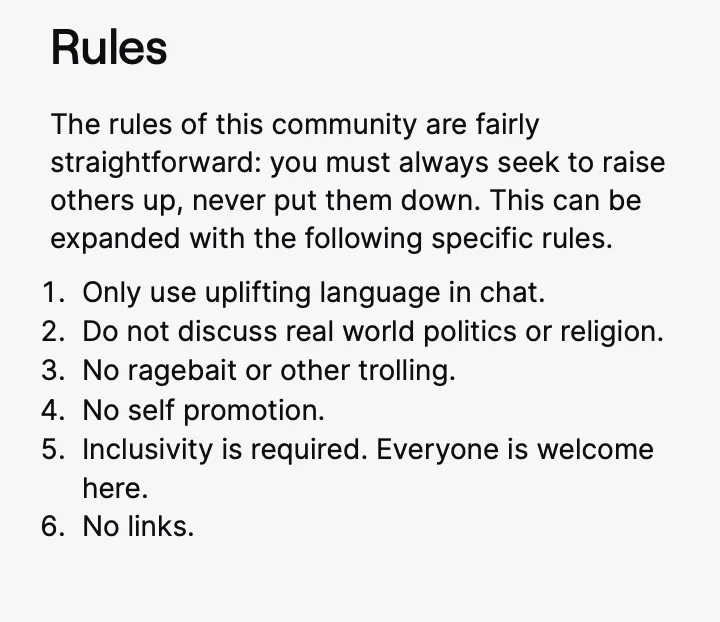
I feel like my rules are pretty straightforward, but I haven't included specific phrasing about hateful language—racism, sexism, transphobia, ableism, because I feel like the first and fifth rules encompasses all of those. As I reflected on this from the original post to this new, revised post, I questioned whether a blanket statement was enough, given what some marginalized creators deal with regularly. Ultimately, though, I decided it's unnecessary to call out any specific groups, as the point here is everyone belongs and it doesn't matter which group you identify with—it matters that you're part of the community and we're happy to have you. This is the same reason why I don't craft rules specifically in support of neurodivergence—when everyone is welcome, your identity remains yours.
Depending what and where you play and stream, you might need specific rules for your own stream. When I was streaming Apex Legends on TikTok, I had to explain to people every few minutes that I don't play with viewers. But, it also gave me an opportunity to encourage people to stream snipe me. It turned into a bit of a fun competition, where I was able to work within my boundaries to still make the game fun.
The Art of Moderation
Set the tone. Lead by example. It starts with you. There is no shortage of phrases that emphasize the importance of a streamer being a beacon of their own rules. Your interactions, reactions, and language will be the first thing your viewers see, and if they see you breaking your own rules, how can they expect you to fairly enforce those rules? Be true to yourself, be open about who you are and why your values are so important to you. Demonstrate them, and acknowledge when you falter. This is especially relevant to streamers who play competitive multiplayer games, where teammates might "throw" a game or refuse to cooperate. You can't control the actions of your five teammates in Marvel Rivals, and letting yourself become toxic to compensate will only cause your stream to devolve.
Whether you self moderate or have a team of dedicated moderators, it's important everyone involved has a consistent pattern. If certain behaviours are zero tolerance, make sure the consequence is the same for everyone. If you think of your moderators as your biggest fans, ask yourself if they're enjoying themselves. If they need to constantly hand out warnings and timeouts because your rules are too lenient, they're not properly engaging with you. I have only a few rules, and breaking those rules in my mind is an instant ban.
That said, it's also a good practice to assume positive intent—with limits. I streamed a lot during COVID and there was a huge influx of people, especially on TikTok, who would join a stream and ask, "Are you vaccinated?" These people weren't trying to engage in meaningful conversation—they were looking for reactions and then moving on. But when someone comments on Spider-Man not contributing anything useful to the team, and that's why you're losing, this is a great chance to steer the conversation based on positive intent. I like to stream with the expectation that my team will see and hear everything I say, so when someone is shitting on my teammate, I want to make sure that we flip that into something productive. Maybe they're learning Spider-Man, and where better to learn than my hard-stuck Silver lobbies? But if the conversation cannot be steered away from negative language, just remember that it's your stream, your rules, and this is why timeouts exist and not everything is a blanket ban.
A Neurodivergent Approach to Conflict
The Internet is a diverse place, and you are bound to be someone's first autistic creator. That person might not recognize or understand the needs of a neurodivergent creator, especially if your boundaries are different from others.
One of my boundaries is I don't do Discord. I don't have a Discord server and will not be setting one up. I understand that a lot of people value Discord for its fantastic community features. When people ask about Discord, I explain that my autism makes the very idea of Discord overwhelming and uncomfortable. Good-intended community members have offered to set it up and run it on my behalf, but I wouldn't feel right about having a community around me that I don't engage with.
Misunderstandings are a great opportunity for education, but only when the subject is open to it. As you get to know people, you will quickly learn when a misunderstanding can be a teaching moment and when it needs to be resolved quietly. But do consider that misunderstandings can happen both ways—so always seek clarification when things are unclear. How do you do that? Ask questions. Conflicts between a streamer and a viewer can be exhausting, especially for autistic creators. I find that keeping strong enforcement of rules goes a long way, and there are very few situations that I feel I need to "fight" with someone in my own stream.
Final Thoughts—Cultivate your Unique Community
You don't need to get political to see the state the world is in today. We all need a pocket of positivity to rely on, and that's one of the things I try to do in my community. I've never understood the value of toxicity when all it does is brings people down. With these thoughts, I hope to provide a better understanding of my own stream and help other autistic creators be leaders of a new wave of positivity, which Twitch, gaming, and the world desperately needs.

Ozject is an autistic content creator with a Bachelor of Fine Arts in Creative Writing and a Master of Business Administration. He streams on Twitch; produces videos for YouTube and TikTok; and writes blog content for other autistic content creators on the OzHole.